
News
Presidential Hopeful Nkwanga Submits Signatures, Declares Liberation Struggle For Uganda

By Gad Masereka
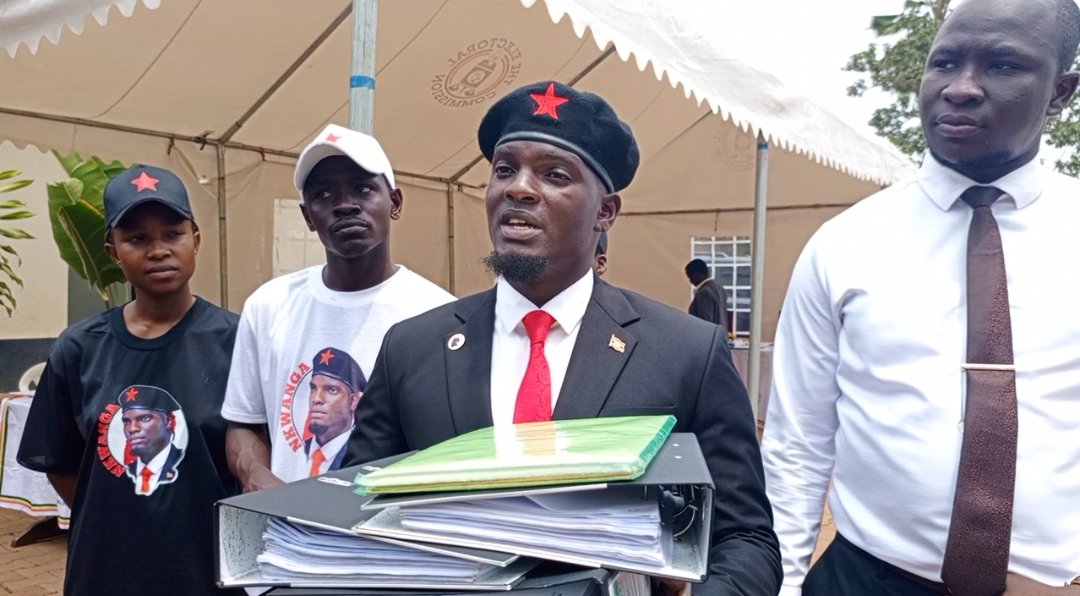
When Nkwanga Micheal walked into the offices of the Electoral Commission today 10th September 2025, he carried with him not just a stack of papers but also a declaration that his “revolution” was no longer a mere idea but a legally recognized candidacy.
With signatures from 108 districts, each surpassing the minimum requirement of 100 registered voters, he presented himself as more than a dreamer, he came as a man who had already begun to mobilise Ugandans behind a shared vision.
“This is the resilience of the peasants who till the soil, the sweat of the working class suffocated by bad policies, and the wisdom of intellectuals choosing to fight for a better Uganda,” he said after confirming submission of the documents.
His words, delivered with fiery conviction, echoed the message he unveiled earlier at KBM Hotel in Kireka when he launched his presidential bid before hundreds of supporters.
At the core of his campaign is a symbol he calls the “red star of liberation.” Each of its five points represents a segment of society he believes has been neglected or betrayed: peasants, workers, intellectuals, the marginalised, and the neutralists those who have distanced themselves from politics altogether.
For Nkwanga, uniting these groups is not only a strategy but also the essence of his struggle. “Even the neutralists must come on board,” he said. “We cannot be seated on an abundance of resources and yet live in scarcity.”
The liberation agenda he outlines rests on four pillars: political freedom, economic independence, social transformation, and ideological renewal.
He argues that Uganda has remained trapped in cycles of corruption and dependency, with leaders who profit from divisions rather than unity. “We are saying no to dictatorship, no to corruption, and no to dependency on foreign countries,” he declared. “Our commitment is as deep as our suffering, but also as rich as our hope.”
Yet the road has not been without challenges. During the signature collection exercise, his team encountered citizens who demanded payment before offering support.
For him, this highlighted not only the corrosive effect of monetised politics but also the urgent need for civic education. “People are selling the future of their children for a few shillings,” he lamented. “It shows us where to focus because politics must once again shape economics, not the other way around.”
Unlike many who have stood as independents, Nkwanga insists he is not an isolated figure without an agenda.
He frames his candidacy as a broad-based liberation movement open to all Ugandans, including those already aligned with political parties but disillusioned by their performance.
His appeal is rooted in inclusivity, which he says sets him apart from past aspirants. “Every political project in this country has started with one group. I am the first candidate raising an agenda that speaks to all five classes of Ugandans at once,” he argued.
Even as he addressed governance and politics, Nkwanga tied his message to everyday struggles. He cited the crumbling state of healthcare, the frustrations of graduates unable to find jobs, and the inequalities in wealth distribution where “one percent owns what belongs to ninety-nine percent.”
He warned that Uganda could not afford to remain silent while infrastructure projects falter, traffic systems fail, and agriculture lacks clear links to markets. “We cannot modernise without honesty, and we cannot export or import with confusion,” he said.
Nkwanga’s tone, though confrontational, also carried a note of urgency. He portrayed Uganda as a house whose foundations are rotting, insisting that pretending otherwise would be reckless. “If after forty years there are no miracles, then it is time to rebuild, not recycle,” he told The New Light Paper.
As the 2026 elections draw closer, his entry adds a new voice to a contest already crowded with aspirants.
Whether his promises of liberation can translate into political momentum remains uncertain, but his speeches have begun to resonate with those who feel abandoned by the political class.
For his supporters, the red star has become more than a symbol, but a rallying point for a struggle they believe is long overdue.