
Health
Ruparelia Foundation to Donate Free Prosthetic Limbs to Amputees at Mulago, Deepening Its Health Outreach Agenda

By Gad Masereka
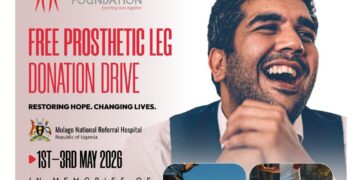
Fresh from the success of a high-impact free eye camp that restored and improved the vision of hundreds of Ugandans, the Ruparelia Foundation is moving its health outreach to a more complex frontier. The philanthropic arm of the Ruparelia Group, founded by businessman Dr. Sudhir Ruparelia, has announced plans to donate free prosthetic legs to amputees at Mulago National Referral Hospital, Uganda’s largest and busiest public health facility.
The initiative marks a meaningful expansion of the foundation’s medical intervention strategy, shifting from restorative eye care into the demanding field of orthopaedic rehabilitation. For many Ugandans living with limb loss, whether from road traffic accidents, diabetes complications, infections, or conflict-related injuries, access to a prosthetic limb has historically been out of reach. The devices are expensive, specialised, and rarely covered by Uganda’s public health financing architecture, leaving many amputees to navigate their lives on crutches or in wheelchairs long after the acute medical emergency has passed.
The choice of Mulago National Referral Hospital as the venue for the programme reflects a strategic decision to reach the broadest possible cross-section of those in need. The hospital’s orthopaedic unit handles some of the country’s most complex limb injury and amputation cases, drawing patients from across Uganda who exhaust local referral options before reaching Mulago. A prosthetic limb donation programme at that level of the health system carries far greater reach than one mounted at a private facility.
The foundation’s decision to pursue this particular intervention did not emerge in isolation. It follows a successful free eye camp that screened and treated a large number of Ugandans over a concentrated period, with many patients receiving cataract surgeries and corrective procedures at no personal cost. That camp reinforced the foundation’s credibility as a serious health philanthropy actor, and the prosthetic programme extends that momentum into territory that is arguably even more life-altering for those it will serve.
Dr. Sudhir Ruparelia has used the foundation over the years as a vehicle for causes spanning refugee support, youth empowerment, education scholarships, and health outreach. The prosthetic limb programme adds a deeply human dimension to that portfolio, touching people who in many cases have quietly resigned themselves to permanent physical limitation due to cost barriers that no amount of personal determination can overcome.
For the beneficiaries, a prosthetic leg represents far more than a medical device. It is the return of mobility, of economic participation, of the ability to walk a child to school or stand at a market stall without depending entirely on another person. When a private foundation steps into that space, it is not performing charity in any superficial sense. It is restoring a foundational human capability that the state has not yet found the resources to guarantee. In that light, what the Ruparelia Foundation is bringing to Mulago is, above all else, dignity.