
Breaking News
Sudhir Ruparelia Elected to Lohana Board of Trustees as Community Installs New Leadership Team

By Gad Masereka
The room at the Lohana Community’s weekend Annual General Meeting carried more history than most gatherings in Kampala’s business district usually do. Around it sat descendants of a Hindu trading community that has survived colonial migration, the terror of Idi Amin’s 1972 expulsion order, and the slow, painstaking work of rebuilding what was lost. The election of a new Board of Trustees on Saturday was, in that context, not just an administrative exercise. It was, for those who understand the Lohana story in East Africa, a moment of institutional continuity.
Among the five members elected to the new board was Dr. Sudhir Ruparelia, Uganda’s most well-known businessman and the founder of the Ruparelia Group, one of the country’s largest conglomerates spanning real estate, hospitality, banking, education, and media. His return to formal leadership within the Lohana Community marks a meaningful reconnection between Uganda’s most powerful Indian-heritage entrepreneur and the community structure from which so many of his generation first drew solidarity and support.
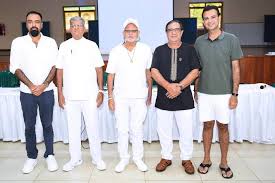
Lohana Executive Committee Chairman Janak Gadhia confirmed the results in a statement issued after the AGM, naming Dr. Hitesh Panchmatia, Dr. Chirag Kotecha, Mr. Bhasker Kotecha, and Mr. Raj Sakaria as the other newly elected trustees. In his statement, Gadhia expressed gratitude to the general membership for a successful meeting and paid tribute to outgoing trustees Mr. Kiran Bhimjiyani and Mr. Chetan Pabari for their years of dedicated community service.
To understand why the election matters beyond the names on the ballot, it helps to understand who the Lohana are and what they have endured on Ugandan soil. Originally from Sindh and Gujarat in northwestern India, the Lohana are a mercantile community whose members began migrating to East Africa in the late 19th century under the expansion of British colonial trade networks. By the middle of the 20th century, they had established themselves as a cornerstone of Uganda’s commercial economy, their family businesses quietly powering much of the retail, manufacturing, and distribution activity in Kampala and the surrounding regions.
Then came 1972. General Idi Amin’s decree expelling Uganda’s Asian population gave families 90 days to leave a country many had lived in for two or three generations. An estimated 40,000 Lohanas had been spread across East Africa at the time, and many of those from Uganda scattered to Britain, Canada, and elsewhere, leaving behind homes, businesses, and institutions built over decades.
The return, when it eventually came from the 1980s onward, was neither simple nor guaranteed. It required courage, capital, and an extraordinary willingness to trust again in a country that had once rejected you. Sudhir Ruparelia became perhaps the most visible emblem of that return, growing from a determined young returnee into a billionaire whose business portfolio reshaped Kampala’s skyline and whose name is now synonymous with Ugandan private enterprise.
His election to the Lohana Board of Trustees is therefore more than a community footnote. It reflects the maturation of a diaspora story that once seemed irreparably broken and signals that the institutions of Lohana cultural and civic life in Uganda are now strong enough to draw their most prominent figures back into active governance roles. The newly constituted board is expected to guide the community through its next phase of development, which observers say will likely involve expanding cultural programming, youth engagement through the Lohana Youth Wing, deepening the work of the Lohana Mahila Mandal, and strengthening the community’s philanthropic footprint across Uganda.
For Sudhir Ruparelia personally, the trusteeship adds a layer of cultural stewardship to a career already defined by institutional scale. In a community that prizes continuity and collective identity, that combination carries a weight that no business deal alone could purchase.