
Breaking News
From Among’s Cullinan To Nekesa’s Cash Convoys: Mulimba Drags Uganda’s Corruption Storm Into NRM Secretariat, Names The Network Behind The Billions

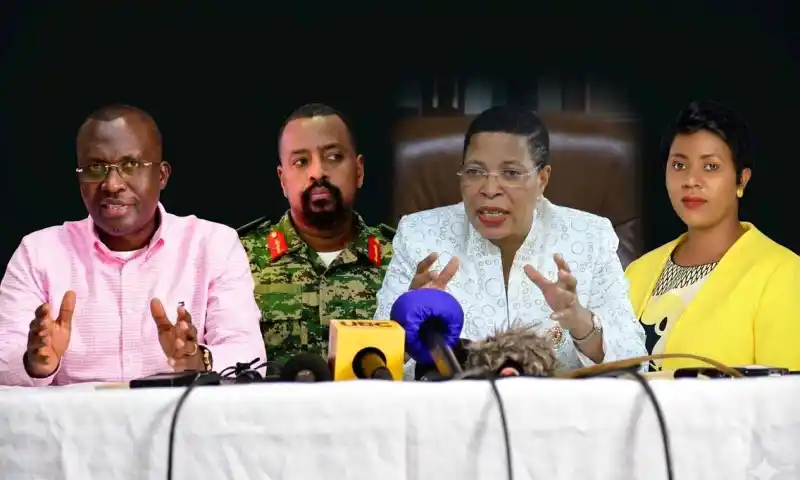
For years, the whispers existed only in the margins of Uganda’s political conversations, in lowered voices at hotel lobbies, in encrypted messages between party insiders, in the knowing silences of NRM officials who had seen too much to speak and too little to stay quiet. This week, John Mulimba ended the silence.
The outgoing State Minister for Foreign Affairs did not leak. He did not hint. He stood up and detonated, accusing senior figures inside the ruling party’s own secretariat of running what amounts to a parallel economy of corruption so deeply embedded in NRM’s internal structures that it has effectively turned the party’s democratic processes into a marketplace where votes are commodities and loyalty is a price tag.
What makes Mulimba’s allegations particularly striking is not simply their severity. It is their specificity. This is not a disgruntled politician offering vague complaints about the system. This is a man who knows the system, has operated within it, and is now describing it from the inside with the precision of someone who no longer has anything to lose.
He named NRM National Treasurer Barbara Nekesa directly, accusing her of coordinating massive cash distributions during the party’s internal elections for the workers’ Member of Parliament seat. Alongside her, Mulimba implicated former Speaker Anita Among, then serving as NRM Second National Vice Chairperson, alleging that the two worked in deliberate coordination to collapse the party’s preferred candidate, Agnes Kunihira Abwooli, and install Fiona Nakku, a woman Mulimba identified without hesitation as Nekesa’s own biological sister.
“The second national vice chairperson, Anita Among, and the national treasurer of NRM, Barbra Nekesa, distributed millions per voter and brought down Kunihira and presented a biological sister to the national treasurer, Fiona Nakku,” he said, each word landing like a count in a formal indictment.
The machinery Mulimba described is not improvised. It is organised, resourced, and apparently rehearsed. Candidates, he said, moved through constituencies in convoys, one vehicle carrying the campaign team and another dedicated entirely to transporting cash. “You would see someone moving with three vehicles, but one of them was specifically carrying money,” he revealed, describing a scene that sounds less like an internal party election and more like a military supply operation, except the ammunition is banknotes.
In his own Samia Bugwe constituency, Mulimba says the operation turned personal. He claims NRM operatives loyal to Among’s network arrived and camped in the area with nearly UGX 7 billion, a war chest assembled not to win votes on merit but to systematically dismantle his political base. His closest mobilisers were allegedly approached and offered between UGX 5 million and UGX 10 million each to switch sides. Ordinary voters, he said, were handed between UGX 50,000 and UGX 100,000 on polling day itself.
The reason for the targeting, Mulimba believes, is straightforward. He stood publicly with Persis Namuganza during her bitter and well-documented fallout with Among inside the NRM. In the party’s unwritten code, that choice made him an enemy of Among’s inner circle, and enemies, it appears, are dealt with through the same currency that drives everything else in this story: money.
What gives the allegations their broader political charge is the moment in which they arrive. Uganda has spent the past several weeks consumed by questions of accountability triggered largely by reports of Among’s acquisition of a Rolls Royce Cullinan worth approximately UGX 3.4 billion. That story unleashed a wave of public fury and ultimately contributed to Among losing the NRM’s endorsement for the speakership of the 12th Parliament. General Muhoozi Kainerugaba publicly withdrew his support. Jacob Oboth Oboth was installed as the party’s preferred candidate instead.
The momentum, in other words, was already moving in the direction of accountability. Mulimba has now redirected it toward a destination that many inside the NRM would have preferred to keep off the map entirely: the party secretariat at Kyadondo.
His timing is not accidental. By linking the corruption debate to the secretariat, Mulimba is essentially arguing that what happened in Parliament is not an isolated scandal but a symptom of a deeper institutional infection. The drone show serves as his most visceral exhibit. The aerial display organised ahead of President Museveni’s inauguration at Kololo, promoted as a landmark technological celebration and reportedly budgeted at nearly UGX 2 billion, lasted barely ten minutes in the skies above Ntinda before sputtering to an end.
Residents who had gathered in anticipation were left confused and disappointed. Insiders alleged that significant portions of the funds never reached the actual technology contractors, with fingers pointing once more toward figures connected to the secretariat.
To the ordinary Ugandan watching all of this unfold, the arithmetic is brutal. Billions for a drone show that lasted ten minutes. Billions allegedly ferried in convoys to buy internal party votes. Meanwhile, public hospitals run short of basic medicines, roads outside Kampala remain impassable, and youth unemployment continues to climb with no structural relief in sight.
Mulimba has framed his demands in terms that leave President Museveni very little political room to manoeuvre. “Museveni should stretch his arm and kick corruption out of NRM and arrest people like Nekesa and her entire group,” the minister said. It is a sentence designed not just as an allegation but as a public accountability test, one that asks whether the President’s much-publicised war on corruption is a genuine institutional reckoning or a carefully managed performance that protects the powerful while punishing the exposed.
The NRM has survived internal crises before. It has absorbed defections, managed dissent, and outlasted nearly every prediction of its decline. But what Mulimba has introduced into the current moment is something the party finds harder to manage than open opposition: a credible insider voice, pointing inward, with specific names, specific figures, and a specific demand that the accountability that brought down Among does not quietly stop at the door of the very institution that helped create her.
The secretariat’s silence, for now, is deafening. And in Uganda’s political climate, silence from the powerful rarely signals innocence. It usually signals calculation.