Business
NAGRC&DB Develops High-Milk-Yielding Pure Ankole Dairy Cattle at Nshaara Conservation Ranch

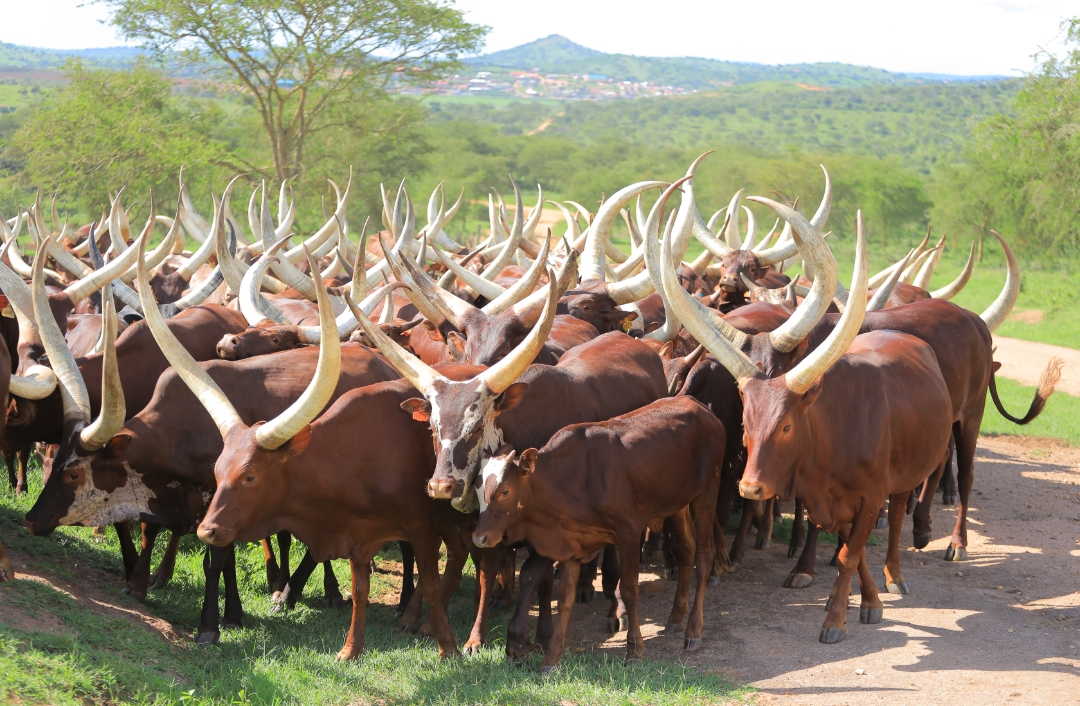
Uganda’s indigenous Ankole Longhorn cattle are showing that higher milk production does not necessarily require exotic genetics, as a deliberate breeding programme at Nshaara Conservation Ranch in Kiruhura District records steadily rising yield from pure Ankole animals.
The programme, led by the National Animal Genetic Resources Centre and Data Bank (NAGRC&DB), is using genetic selection, pedigree management, performance recording and improved nutrition to identify and multiply Ankole cattle with naturally superior milk producing ability while preserving the breed’s genetic identity.


The initiative began about three years ago when NAGRC&DB started screening the cattle population at Nshaara for animals with stronger dairy potential. Superior Ankole genetics were also brought in from recognised sources, including the Kisozi Ankole Longhorn conservation and improvement herd.
The approach is deliberately different from crossbreeding. Rather than introducing exotic dairy genetics, the breeding team is selecting from genetic variation that already exists within the Ankole population and progressively concentrating traits associated with higher milk production.
At the centre of the programme is a nucleus population selected using defined production and functional characteristics. Milk yield is the primary trait, followed by lactation length, udder conformation and calving interval. Replacement heifers are assessed using their mothers’ milk production, growth and fertility records, together with physical characteristics such as body structure, udder development and temperament.
As superior female lines emerge, attention is also placed on the selection of breeding bulls from high performing maternal families. Since bulls can pass milk production traits to their daughters, candidates are assessed partly on the performance of their dams. Growth rate, body size, age at maturity, reproductive soundness, testicular development, libido and temperament are also considered.
Dr Innocent Tuwangye, manager of Nshaara Conservation Ranch, said the programme is intended to improve the Ankole without changing what makes the breed distinct.
“We are not trying to turn the Ankole into an exotic dairy cow. We are identifying superior dairy traits that already exist within the pure Ankole population and systematically selecting and multiplying those genetics. The objective is to develop an Ankole animal that produces more milk while retaining the adaptability, resilience and genetic identity for which the breed is known,” he said.
Behind the selection process is an expanding body of animal performance data. Production records are combined with information on reproduction and animal health, with details kept in physical farm records and NAGRC&DB’s Integrated Livestock Management Information System.
The system allows breeders to build individual performance histories and trace production outcomes to particular animals and maternal lines. Historical records, including peak milk yields across successive lactations, are then used to guide decisions on which animals should contribute to the next generation.
The results recorded so far show a marked change in herd performance. In 2023, average milk productivity stood at 5.2 litres per active cow per day, with annual recorded production of about 56,040 litres. The active milking population increased from 24 cows in January to 35 by December.
The gains continued in 2024, when average productivity rose to seven litres per cow per day and annual recorded milk production reached about 106,358 litres. During the same year, the number of milking cows increased from 36 at the beginning of the year to 47 by December.
By December 2025, average productivity had climbed to 8.6 litres per cow per day, while annual recorded production reached approximately 168,285 litres. The milking population expanded from 47 cows in January to 60 by December.
Taken together, the records indicate that average productivity increased by about 65.4 percent between 2023 and 2025, alongside a steady expansion of the selected milking population.
Individual animals are also providing evidence of the productive potential within the indigenous breed. Under traditional production conditions, an Ankole cow may produce an average of about two litres during morning milking. At Nshaara, selected cows are now regularly recording about five to 10 litres during a single morning milking session, while a few exceptional animals have reached up to 12 litres between their second and seventh lactations.
One cow has recorded a peak morning yield of 14 litres, offering a striking example of the production potential the breeding team believes can be developed further through systematic selection.
Yet the experience at Nshaara has also shown that genetics alone cannot deliver higher production. As the selected animals began demonstrating greater potential, NAGRC&DB strengthened their feeding programme by supplementing grazing with hay and silage produced at the ranch.
The highest individual yields have been observed under the improved feeding regime, highlighting the relationship between genetic potential and the environment in which an animal is managed.
Dr Peter Beine, executive director of NAGRC&DB, said the experience has reinforced the need to treat breeding and feeding as complementary components of livestock improvement.
“Our records are increasingly showing us that breeding and feeding must move together,” he said. “Selection identifies the animal with superior genetic potential, but nutrition determines how effectively that potential is expressed. We are therefore using the production data not only to select our breeding animals but also to refine feeding and management protocols for the emerging Ankole dairy population.”
The programme is now moving beyond the identification of individual high performing cows to a more demanding stage of consolidating those traits across families and successive generations.
For the breeders, an exceptional cow producing 14 litres is encouraging, but it is not the ultimate measure of success. The longer term objective is to make higher milk production increasingly repeatable, heritable and predictable within the pure Ankole population.
Achieving that will require continued pedigree recording, individual animal identification, selection of elite cows, careful choice of replacement heifers from proven maternal lines and the use of bulls originating from superior dams. The resulting offspring will also have to be systematically evaluated before their genetics are incorporated into future breeding decisions.
“Our real measure of success will not simply be one exceptional cow,” Beine said. “The breeding objective is to establish a population in which superior milk production can be consistently reproduced from one generation to another. That is why pedigree integrity, individual animal identification, performance recording and selection of proven maternal and sire lines are central to what we are doing at Nshaara.”
For Uganda’s livestock sector, the work represents a broader effort to demonstrate the value of indigenous animal genetic resources in improving productivity. The Ankole is widely valued for characteristics such as adaptability and resilience, but the Nshaara programme is seeking to add another dimension by demonstrating that those attributes can be retained while productive traits are progressively strengthened.
What started as an effort to identify naturally superior milk producing Ankole cows is therefore developing into a structured breeding programme. Its success will ultimately be measured not by isolated record holders, but by whether Nshaara can establish a genetically stable, productive and resilient pure Ankole population whose improved milk production can be passed reliably from one generation to the next.
Send Us Your Story
If you would like your article or opinion published on The New Light Paper, one of Uganda’s trusted news platforms, send your submission to thenewlightpaper@gmail.com.