
News
President Museveni Hails Indian Community As Pillars Of Uganda’s Economic Transformation

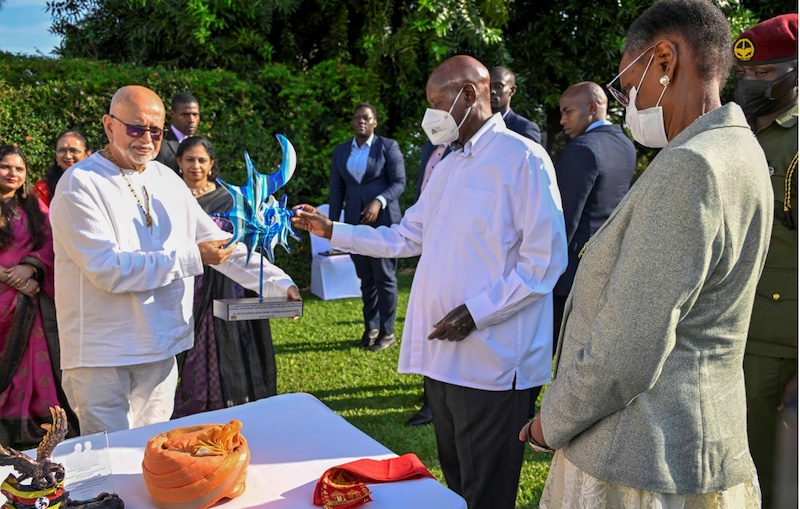
President Yoweri Museveni has hailed the Indian community in Uganda for their enduring role in rebuilding the country’s economy, describing them as indispensable partners in national development. The President made the remarks during a vibrant Diwali celebration held at State House Entebbe, where hundreds of Indian business leaders and families gathered to mark the festival of lights.
Addressing the gathering, Museveni commended the community for its continued investment in key sectors such as manufacturing, finance, and real estate, noting that their entrepreneurial drive has significantly strengthened Uganda’s tax base. “Thank you so much for your contribution to the economic development of this country,” he said. “Encourage more people to invest here, bring tourists, and continue building this partnership that benefits all Ugandans.”
Figures from the Ministry of Finance show that although Indians constitute less than one percent of Uganda’s population, they contribute about 65 percent of the country’s income tax revenue. Museveni said this performance reflects not only their business acumen but also the success of Uganda’s liberal economic policies under his government.
He singled out business magnates such as Dr Sudhir Ruparelia, the Madhvani family, and the Mehta Group for transforming Uganda’s private sector landscape. “People like Sudhir came here with just twenty-five thousand dollars, and today his businesses are worth over one billion dollars. This is the same land, the same people, but under a different vision,” Museveni said, drawing applause from the audience.
The President used the occasion to revisit one of the darkest episodes in Uganda’s post-independence history — the 1972 expulsion of Asians by then-President Idi Amin. He described the decision as an act of ignorance that crippled the country’s economy and stained its reputation. “There was no legitimate reason for Amin’s actions. It was pure chauvinism. The expulsion of Indians destroyed our economy and hurt Africans even more,” he said. Museveni added that welcoming back the Indian community in the 1990s helped restore investor confidence and revitalised trade and industry.
Responding to a call from the community for constitutional recognition as one of Uganda’s tribes, Museveni said Indians already form part of the country’s social fabric. “Sociologically speaking, the Indians already have a known tribe, like the Bazungu or Bahalabu. What remains is for it to be considered constitutionally,” he said, hinting at future discussions on the matter.
The President also acknowledged the community’s philanthropic contributions, including the donation of 65,000 units of blood to hospitals and military facilities, and funding for over 230 life-saving heart surgeries for Ugandan children in India. Another 100 children are expected to benefit from the initiative next year. “Your compassion goes beyond business; it touches lives in the most meaningful ways,” Museveni noted.
The Indian High Commissioner to Uganda, Singh Rawat, thanked the government for maintaining a stable and welcoming environment that allows businesses to thrive. “Under President Museveni’s leadership, Uganda has become a country of opportunity and progress,” he said. Minister for the Presidency Milly Babalanda echoed this sentiment, describing the Indian community as a “pillar of resilience and productivity” that continues to drive industrial growth.
Chairman of the Indian Association of Uganda, Paresh Mehta, said the expulsion of 1972 left a lasting scar, not only on Indians but also on Ugandans who lost partners in trade and industry. “Uganda lost part of its enterprising spirit then, but under your leadership, that spirit has been reborn. The vision has changed, and with it, our shared future,” he said.
Uganda and India share a relationship that spans over a century, beginning with the arrival of Indian traders in the early 1900s and evolving into a multifaceted partnership in trade, technology, and education. Today, bilateral trade between the two countries stands at over $1.2 billion, a figure Museveni said reflects the strength of trust and collaboration built over the years.
As the celebrations drew to a close, guests joined in lighting ceremonial lamps — a symbolic gesture of light triumphing over darkness.
For many in attendance, it was more than a cultural event; it was a reaffirmation of unity, resilience, and the enduring bond between Uganda and its Indian community, one that continues to illuminate the country’s path toward economic transformation.


