
Health
RR Eye Camp Transforms Lives In Bukedea As Ruparelia Foundation Unveils Expanded Free Eye Care Services

By Gad Masereka
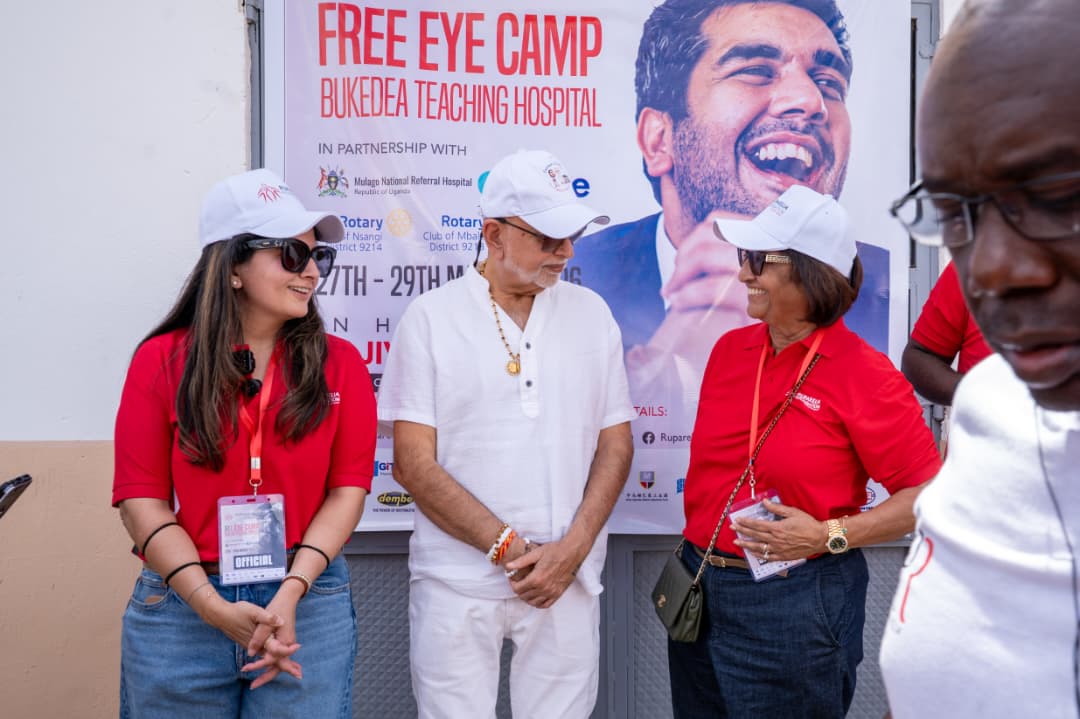
Thousands of patients have converged on the grounds of Bukedea Teaching Hospital in Bukedea District, overwhelming organisers of the fourth edition of the RR Eye Camp as demand for free eye care services far outstrips initial projections.
Organised by the Ruparelia Foundation in honour of the late Rajiv Ruparelia, the camp has evolved into one of the most comprehensive community health interventions in eastern Uganda, offering everything from cataract surgeries and prescription glasses to a blood donation drive, all at no cost to patients.
Speaking to the media, Sheena Ruparelia, representing the Ruparelia Foundation, described this year’s camp as a significant leap forward from its predecessors. “We’ve arranged an eye camp to screen individuals for cataracts, for general eye issues, as well as for prescription and reading glasses,” she said. What sets this edition apart, she explained, is the introduction of surgical procedures for children alongside individualised prescription glasses, a first in the camp’s history. “It’s actually our fourth eye camp, and this year we’ve introduced not only surgeries for children, but also prescription glasses for children,” she noted, adding that children’s prescriptions require personalised processing in Kampala. “It’s a big milestone for us, because we have to actually physically send the glasses back to Kampala to individualize their prescriptions for each individual child.”
The scale of the undertaking is considerable. Organizers say the camp has cost over Shs2 billion, covering surgeries, glasses, medication, and the full range of services on offer. A team of 15 Ugandan doctors, including surgeons, was deployed with complete equipment to ensure patients receive treatment on site rather than being referred elsewhere. That distinction, Sheena stressed, is central to the foundation’s philosophy. “Most screening camps in Uganda usually just screen patients and allow them to find their own way for treatment. For us, this is a problem. We are here to provide solutions,” she said.
By the time she addressed the media, the numbers already told a story of urgent need and community trust. The foundation had anticipated screening around 4,000 people over the course of the camp, but the turnout quickly surpassed expectations. “We are overwhelmed by the attendance. So far, we estimate there are about 2,000 people waiting, we have registered 300, completed 10 surgeries, two of them children, and we have 30 more waiting,” she said. Dozens of patients had already received prescription glasses, and the blood donation drive running alongside the eye camp had collected 45 units.
Sheena also acknowledged the support of key partners, including Mulago Hospital, Seek Care, Anita Foundation, and Victoria University, whose students formed a significant part of the volunteer corps.
Behind the statistics lies a deeply personal motivation. Sheena traced the origins of the initiative to her parents and to the transformative moments that have come to define it. “They once told me about a 90-year-old woman who had not seen for over 10 or 15 years, who came to one of the camps and walked out seeing. That is the reason we continue to do this,” she said. This year’s camp carries additional emotional weight as a tribute to Rajiv Ruparelia, whose death prompted the family to expand rather than scale back. “With the tribute to Rajiv, who was larger than life, we decided this camp would be bigger, with more services. Rajiv would always go beyond the norms, and that is why we are here today.”
That portrait of Rajiv as someone who led with generosity was echoed by Lawrence Muganga, who shared a personal story that captured the character of the man being honoured. “We are here to remember a friend, a brother of ours, and to do the things he loved doing,” he said.
He recalled a difficult period when he was living at Bukoto Heights and ran out of funds after two weeks. Having been given Rajiv’s number by management, he reached out expecting little. “He had never seen me, but he said, ‘As long as she pays for her meals, let her stay for one more week.’ That is the man we are remembering today.”
Muganga also praised the camp’s model of care, emphasising that patients leave with tangible outcomes rather than referral slips. “You are not just screened and sent away. You receive treatment, surgery, glasses, and even aftercare. That is something very important,” he said.
He noted that over 100 volunteers had mobilised for the camp, describing their commitment as vital to managing the unexpectedly high turnout, and indicated that the foundation intends to replicate similar outreaches in other parts of the country.
The camp’s reach has already stretched well beyond Bukedea District. Bukedea MP-elect Beecham Okwere David, speaking on behalf of local leadership, pointed out that patients had travelled from Mbale, Gulu, and even across the border from Kenya to access services. “This is no longer just about Bukedea or Teso. This is now a national camp,” he said. He was blunt about the financial reality that makes the initiative so consequential. “Even if someone sold all their property, they might not afford such treatment. But what has been done here is something we must deeply appreciate.” Invoking local tradition to convey the depth of community gratitude, he added, “We kneel to show gratitude for such a gesture.”
As the camp continues to process patients, the convergence of large numbers, expanded medical services, and the personal tributes woven throughout the event has given this edition a character that goes beyond a health outreach.
It is, in equal measure, a statement about what private philanthropy can achieve when directed at communities where public health infrastructure often falls short, and a living tribute to a man whose instinct, by every account shared here, was simply to help.