
Politics
President Museveni Rallies NRM Leaders To Protect Gains, Spearhead Uganda’s Next Phase Of Growth

By Gad Masereka
President Yoweri Museveni has called on members of the ruling National Resistance Movement to take a frontline role in combating corruption and advancing Uganda’s socioeconomic transformation, framing both as critical pillars for the country’s progress in the coming decade.
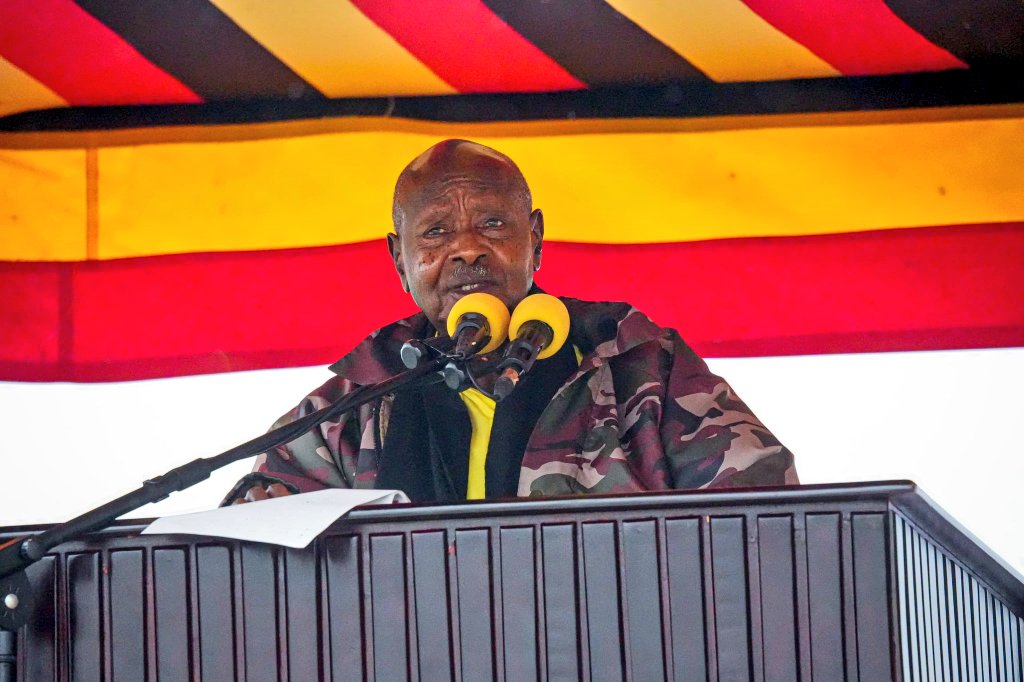
Speaking to thousands of delegates at Kololo Independence Grounds on Monday during the inaugural National Conference for Special Interest Groups, the NRM National Chairman reflected on Uganda’s economic journey since 1986, when the economy was valued at $3.9 billion, compared to today’s $66 billion.
He said the long-term target was to grow Uganda into a high middle-income country with a projected economy of $500 billion.
The President outlined what he described as five distinct phases of growth that have defined Uganda’s development path minimum recovery, expansion of production, diversification, value addition, and the current transition toward a knowledge-based economy.
The president pointed to examples of domestic innovation such as electric buses by Kira Motors, local vaccine development, and computer assembly, saying these reflect Uganda’s readiness to compete globally.
Museveni emphasized that the shift away from subsistence farming remains central to this transformation.
He recalled that in 2013, nearly 68 percent of Ugandan households lived outside the money economy, but that figure has now dropped to 33 percent. “Every family must produce both food and cash,” he told the delegates, insisting that the remaining households must be brought into the fold of income-generating activity.
To illustrate his point, he cited Joseph Ijara, a farmer from Serere who reportedly earns Shs3 million a day from just 2.5 acres of land, as evidence that targeted commercial farming can uplift families if widely embraced.
He reiterated the four sectors he has long championed as drivers of prosperity—commercial agriculture, industry, services such as tourism, and ICT.
Turning to governance, Museveni issued a stern warning on corruption, particularly at the local government level where he said public programmes are most vulnerable to abuse.
He singled out the Parish Development Model as one scheme that must be protected from mismanagement. “Don’t allow corrupt people to steal Parish Development Model funds or demand bribes. Stop those who steal public money—we shall arrest them,” he said, adding that communities should demand accountability for resources such as the UGX 1.3 billion disbursed annually for road maintenance.
The President also urged vigilance within the police force, which he said must not only prevent crime but also act as a reliable partner to citizens in service delivery.
Education and healthcare featured prominently in his address. He reiterated his long-standing pledge to ensure free primary and secondary education, castigating head teachers who continue to levy illegal charges on parents. “Let us not let down the children of the poor. Stop these abuses of charging school fees. Support me to fully implement free education,” he said.
On health, Museveni credited Uganda’s immunisation campaigns with eradicating smallpox and cutting down measles prevalence, but warned that drug theft and mismanagement within hospitals continue to undermine progress.
He advocated for stronger preventive healthcare measures, saying they would ease the strain on the country’s health system while improving outcomes for families.
The message of accountability and collective responsibility was echoed by NRM Secretary General Richard Todwong, who reminded party members that unity must take precedence over individual ambition. “We are members of one family. Focus on the bigger picture — the mission, objectives, and goals — rather than personal ambitions,” he urged.
The Kololo gathering brought together representatives from across the NRM’s Special Interest Groups, including youth, women, veterans, historicals, the elderly, workers, and entrepreneurs.
Later in the day, delegates were expected to elect SIG representatives to the party’s National Delegates Conference, a process seen as central to strengthening the NRM’s internal structures and preparing it for the next political cycle.