News
Milestone: PDM farmers applaud NAGRC for their quality dairy heifers, piglets and poultry chicks

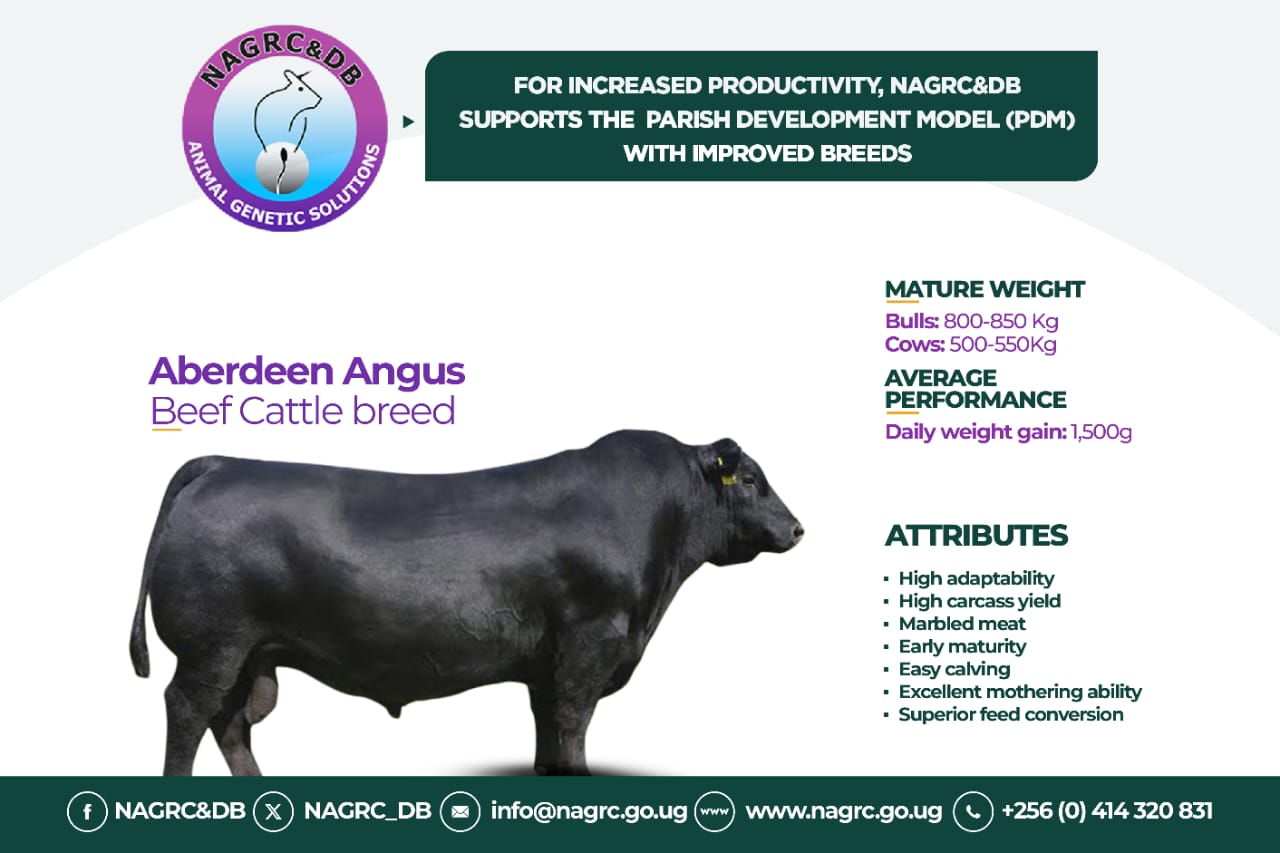
Kampala: A fresh round of government investment in livestock breeding is set to put more improved dairy cows, piglets and poultry chicks into the hands of rural households, as the National Animal Genetic Resources Centre and Data Bank (NAGRC&DB) moves to widen its supply chain to farmers under the Parish Development Model (PDM).
The push follows a Shs56.96 billion allocation Parliament approved in March for livestock breeding infrastructure, including breeding centres at Bukedea and Serere, financed under the Fourth National Development Plan.


Agency officials say the money will fund mass multiplication of improved breeds, restocking drives and community breeding schemes designed to reach smallholders who have historically relied on low-yield local stock.
The expansion plans took shape at a two-day board and management retreat in Entebbe on August 6 and 7, where NAGRC&DB leadership mapped out priorities for the 2026/2027 financial year around the National Animal Breeding Strategy and Action Plan – a framework built to commercialise breeding and safeguard indigenous genetics across dairy, beef, goat, pig, poultry and fish value chains.
Board Chairperson Ben Anyama framed the coming year’s work as less about volume and more about reach, telling colleagues at the retreat that the goal is making superior genetics available to farmers “regardless of scale.” Mass breeding and multiplication programmes will be intensified, he said, to widen access to climate-resilient, high-performing breeds.
For farmers already receiving animals through the programme, the payoff is showing up in milk pails, egg trays and household budgets. PDM beneficiaries interviewed separately credit the improved heifers, piglets and chicks supplied by NAGRC&DB with lifting them out of pure subsistence farming and into small-scale commercial production — more milk to sell, more eggs to trade, and a steadier flow of income than local breeds typically provide.
Kasolwe farm anchors the breeding push
Much of the multiplication work runs through Kasolwe Stock Farm, a property spanning more than a square mile that NAGRC&DB has built into a hub for both breeding and feed production. The farm grows its own forage grasses, hay, energy-dense maize and protein supplements to support the animals it multiplies on-site.
Kasolwe is also home to the Kasolwe Brown goat, a breed developed through the agency’s genetic improvement work. Dr Katali Benda, NAGRC&DB’s programme officer for small ruminants, describes the goat as drought-tolerant, fast-growing and comparatively hardy against common goat diseases.
Mature females can reach 65 kilogrammes and males up to 75 kilogrammes, he said, and does can produce as many as four kids a year — a reproduction rate that makes the breed appealing to farmers looking to build herd numbers quickly.
Busoga as the testing ground
The Busoga sub-region has served as an early proving ground for the model. NAGRC&DB says it has distributed more than 500,000 improved Kuroiler chicks, 10,000 crossbred bulls, 5,000 pigs and 165 Kasolwe Brown goats there, alongside artificial insemination services that have reached over 10,000 cattle in the past two years.
The Kuroiler bird, a dual-purpose breed, is central to the agency’s poultry push: it can lay 150 to 200 eggs a year against roughly 40 for many indigenous chickens, and reaches market weight of two to 3.5 kilogrammes within five months.
Farmers in the sub-region have also been organised into breeding societies and trained in modern husbandry, disease control and genetic selection, a template the agency intends to extend into other parts of the cattle corridor.
Feed production and inclusion targets
Behind the breeding numbers sits a parallel investment in nutrition. Heavy-duty feed machinery at Kasolwe now produces compounded feeds for poultry, pigs and dairy cattle, addressing a bottleneck that often undercuts genetic gains when animals aren’t properly fed.
NAGRC&DB says women, youth and persons with disabilities will be prioritised as the rollout expands, part of a broader push to open the livestock economy to groups that have often been sidelined from it.
The stakes extend well beyond individual households.
Uganda Bureau of Statistics figures presented at the Entebbe retreat show livestock supports roughly 71 percent of Ugandan households and contributes about 4.5 percent of national GDP — 17 percent of agricultural GDP, with dairy alone accounting for 40 to 50 percent of the livestock sector’s share.
For an agency now sitting on nearly Shs57 billion in fresh infrastructure funding, translating that reach into higher productivity is the task ahead.
Send Us Your Story
If you would like your article or opinion published on The New Light Paper, one of Uganda’s trusted news platforms, send your submission to thenewlightpaper@gmail.com.