News
Karenga Residents Demand Action as Reproductive Health Uganda-Led Dialogue Tackles Teenage Pregnancy Crisis

By Richard Onapatum
KARENGA, Uganda — Concern over rising teenage pregnancies and child marriages has sparked calls for urgent action in Karenga District, with residents, local leaders and government officials urging stronger community involvement to protect girls and keep them in school.
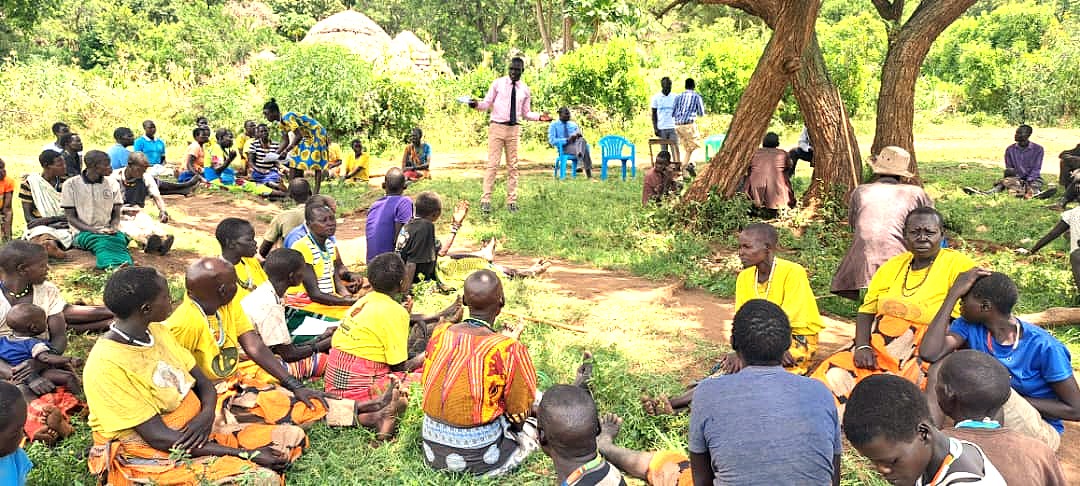
The call was made during a community Baraza organized by Reproductive Health Uganda (RHU) on 22 July 2026 in Loruma Ward, Kangole Parish, bringing together parents, youth, local leaders, government officials and development actors to discuss challenges affecting adolescent girls and vulnerable households.

The dialogue was held under the STRENGTH – Strengthening Community-Based Climate Adaptation in Uganda and Sudan Project, funded by DFPA. While the project focuses on strengthening community resilience to climate change, discussions highlighted how environmental pressures, poverty and social vulnerabilities are contributing to challenges affecting women and children.
Residents described teenage pregnancy and child marriage as growing concerns that continue to disrupt girls’ education, affect their health and limit their future opportunities.
During the Baraza, community members identified several factors driving teenage pregnancies, including poverty, food insecurity, school dropout, peer pressure, poor parental supervision and alcohol abuse among young people.

They also linked the challenge to climate-related pressures affecting households. Residents explained that human-wildlife conflict forces some families to spend long hours protecting crops from wild animals, leaving children with limited supervision and increasing their vulnerability to exploitation and abuse.
The community further raised concerns about the long distances girls travel to access water, saying unsafe routes and congestion at water sources expose them to harassment and other risks.
Napeyok Paska Faith, a local councillor, said the awareness sessions, community Barazas and dialogues organized by Reproductive Health Uganda (RHU) have strengthened her commitment to mobilizing communities against teenage pregnancies and child marriage.
She explained that before RHU interventions, some community members were resistant to efforts aimed at educating teenagers, making it challenging to sustain awareness activities. However, the knowledge, skills and confidence gained through the RHU-led engagements encouraged her to continue advocating for the protection of girls.
“Since RHU started conducting awareness sessions, community Barazas and dialogues, we have been able to understand these challenges better and encourage parents and young people to take action. At first, some people rejected my efforts to educate teenagers, but the knowledge and confidence I gained from these sessions motivated me to continue organizing awareness activities,” she said.
Faith urged parents to take greater responsibility in guiding and protecting children, saying that keeping girls in school and preventing early pregnancies requires collective commitment from families and the wider community.
Senior Development Officer Abotto Moses emphasized the importance of community participation in addressing challenges affecting vulnerable households, saying lasting solutions require cooperation between families, leaders and development actors.
He noted that strengthening community systems remains critical in responding to social challenges while building resilience among households affected by climate-related pressures.
Health concerns were also central to the discussions, with Health Assistant Achoro Gabriel educating residents on reproductive health, hygiene and sanitation.
Achoro encouraged parents and young people to seek accurate information and utilize available health services, noting that awareness and early intervention are key in preventing challenges affecting adolescents.
Meanwhile, District Probation Officer Francis Lodungu called on residents to promptly report cases of child abuse, defilement, child marriage and teenage pregnancy through local leaders, Community Development Officers, the Probation Office and Police.
Lodungu stressed that protecting children requires collective responsibility from parents, schools, communities and government institutions.
The meeting concluded with several resolutions aimed at addressing teenage pregnancies and improving child protection. Community members agreed to strengthen parental responsibility, promote school retention, improve reporting of child protection cases and organize wider stakeholder engagements involving political, cultural and technical leaders.
Participants also committed to strengthening village-level child protection mechanisms and conducting regular awareness campaigns on positive parenting, reproductive health and children’s rights.
Organizers said the Baraza demonstrated the importance of community dialogue in addressing challenges affecting women and children, particularly in areas facing the combined effects of climate change, poverty and limited access to essential services.
As Karenga continues to confront these challenges, leaders expressed optimism that stronger collaboration among families, government agencies and development partners will help create a safer environment where girls are protected, remain in school and have opportunities to achieve their full potential.
Send Us Your Story
If you would like your article or opinion published on The New Light Paper, one of Uganda’s trusted news platforms, send your submission to thenewlightpaper@gmail.com.